
November 25, 2026
How often can you use hypochlorous acid spray on reactive skin?

Use hypochlorous acid spray on reactive skin only as often as the product label directs and your skin comfortably tolerates; there is no single daily frequency that fits every formula or every person. Start with a small-area test rather than repeated full-face applications, and stop if the spray causes burning, itching, swelling, or worsening redness.
- How often to use hypochlorous acid spray on reactive skin depends on label directions and individual tolerance.
- Xoxo Gina HALO™ Wellness Mist is a hypochlorous acid spray; its pH does not establish your application schedule.
- Test a small area first, keep your routine simple, and stop if irritation develops.
- A facial mist does not replace moisturizer, sunscreen, or prescribed skin treatment.
How often can you use hypochlorous acid spray on reactive skin?
Follow the bottle, then let tolerance set the limit. A recommendation for a different hypochlorous acid spray does not establish the right schedule for yours. Check application directions, intended uses, and warnings before deciding where the spray belongs in your day.
For product-specific details, read the Wellness Mist product information. Treat a suggested routine as instructions to assess carefully, not a reason to keep applying a product that feels uncomfortable.
These situations call for different decisions:
| Situation | Best for | What to do | Benefit of this approach | Limitation |
|---|---|---|---|---|
| You have not used the formula before | First-time users | Test a small area before wider use | Limits the area exposed during introduction | A comfortable test does not guarantee future tolerance |
| You tolerate the formula and understand its directions | An established routine | Stay within the label instructions | Keeps use tied to the actual product | Comfort does not justify unlimited applications |
| Your skin stings, itches, or becomes redder | Recognizing a reaction | Stop using the spray | Avoids continuing exposure to a suspected irritant | Persistent symptoms need medical assessment |
| Your skin is flaring or you use prescribed treatment | Individual guidance | Ask your dermatologist before adding the spray | Keeps the decision connected to your care plan | General skincare advice cannot set your personal schedule |
There is no need to reach an application target. If you cannot explain what an extra spray adds to your routine, pause before making it a habit.
Why this matters
Reactive skin makes a simple question feel complicated: is the problem the product, the amount, the timing, or something else you used alongside it? Adding repeated applications and several new products together makes that question harder to answer.
For your 2026 skincare routine, make the introduction easy to track. Keep familiar products steady, introduce the mist separately, and pay attention to how your skin feels afterward—not just immediately after spraying.
A facial spray is an optional step. You do not need to keep using a mist to prove that your skin can adjust to it. Persistent discomfort is a reason to stop, not a milestone to push through.
Start small. Keep the rest familiar.
A small-area test is a cautious introduction, not a guarantee. It helps you check one formula on a limited area before making it part of a larger routine.
Read the label
Confirm that the product is intended for the area where you want to use it. Directions for facial skincare and directions for cleaning surfaces serve different purposes; do not substitute one for the other.
Check warnings as well as application instructions. If the label does not answer a question about your intended use, ask the manufacturer rather than borrowing directions from another bottle.
Test a small area
Apply the product to a small area of skin according to its directions before using it more widely. Do not choose skin that is already visibly irritated as your testing ground.
The American Academy of Dermatology recommends testing new skincare products on a small area before adding them to your routine. If you have a history of contact allergy or significant reactions, ask a dermatologist how to introduce the product; a home test does not replace medical patch testing.
Keep products steady
Avoid introducing the mist alongside a new exfoliant, cleanser, serum, and moisturizer. If a reaction follows several changes, you will have less clarity about the cause.
Keep the routine familiar while assessing the new step. You are checking whether the spray fits your skin—not testing how many new products your skin can handle together.
Check your response
Notice burning, itching, increased redness, dryness, or swelling. Stop using the product if those symptoms develop, and seek medical advice when symptoms persist or are significant.
A brief comfortable application does not settle every question about repeat use. Continue paying attention after the product becomes familiar, especially if your skin condition or other skincare changes.
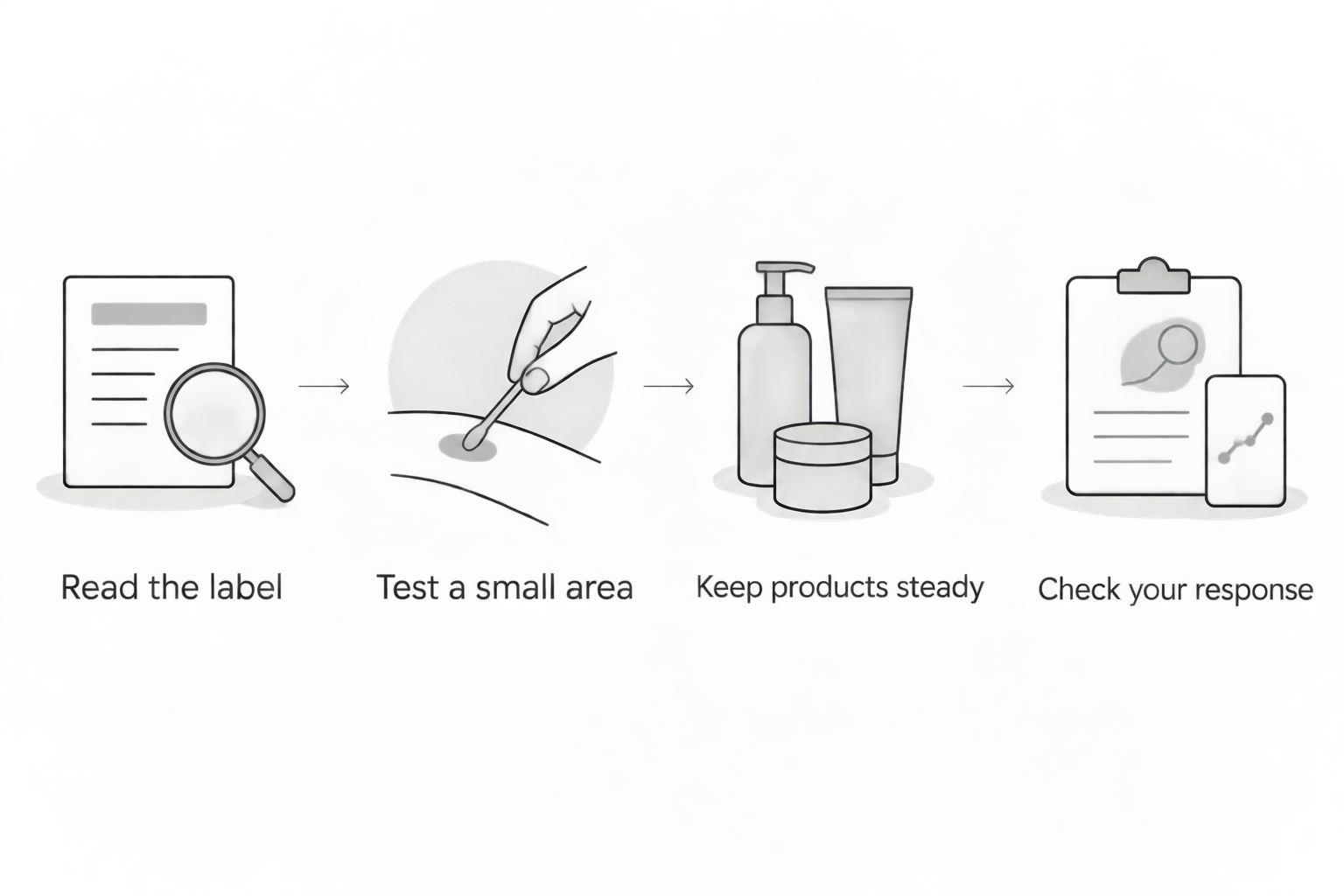
These steps are a useful starting point in 2026 whether you are simplifying a crowded bathroom shelf or adding a mist for the first time. Keep the decision tied to your skin and the bottle in front of you.
Why your application schedule varies
The word hypochlorous does not tell you everything about a finished spray. Your routine needs to account for the product and the condition of your skin.
- Label directions. Intended areas, application instructions, and warnings belong to the specific formula. Do not transfer them from another product.
- Your current skin condition. A routine you tolerate when your skin feels settled is not automatic permission to continue unchanged during a flare.
- The complete formula. Check the ingredient list rather than choosing by the highlighted ingredient alone. Different products need their own assessment.
- Other skincare products. Cleansers, exfoliants, and treatments are part of the same routine. Consider the whole routine when irritation appears.
- Prescribed treatment. Follow your clinician's instructions when deciding whether to add another topical product or change its timing.
- Your response after use. Burning or worsening redness outweighs a routine suggested in a video or review. Stop and reassess rather than adding applications.
None of these factors creates a universal daily number. Together, they explain why a personalized schedule is more useful than copying someone else's.
After the gym? Do not spray by default.
A workout creates a convenient reminder to check your skincare routine. It does not automatically create a need for another mist application.
If you want to use a hypochlorous acid spray after exercise, follow its directions and consider what you have already applied. Avoid turning every workout, commute, or change of clothes into another application simply because the bottle is nearby.
A mist also does not replace cleansing when your skin needs cleansing, or moisturizer when your skin needs moisture. Keep those jobs separate rather than asking a single spray to do everything.
For a gym-bag routine in 2026, simplicity means fewer decisions—not unlimited spraying. Decide where the product fits, follow its storage instructions, and stop if your skin becomes uncomfortable.
What to check in the formula
An ingredient name is a starting point, not a complete assessment of a finished product. Look at the intended use, full ingredient list, directions, and storage information together.
The same restraint applies to pH. A stated pH tells you about acidity; it does not, by itself, establish that a formula will suit your reactive skin or tell you how frequently to apply it.
Bottle size answers a different question: how much product the container holds. It does not establish a dose, a daily schedule, or better skin tolerance.
When choosing a spray in 2026, separate these facts instead of treating them as interchangeable promises. Clear product information helps you make a decision, but your response still matters.
Where Xoxo Gina HALO™ Wellness Mist fits
Gina Rivera is the founder behind Xoxo Gina HALO™. For reactive-skin shoppers who want to assess a hypochlorous acid mist, the practical starting point is the product's documented information—not an assumption about how often everyone should spray.
Xoxo Gina HALO™ Wellness Mist is an option for shoppers seeking a hypochlorous acid mist for face and body. The product comes in a 5 fl oz / 150 mL bottle, and its description states pH 4.5 and identifies purified water and hypochlorous acid among its ingredients.
Those details give you concrete information to review. Their limit matters just as much: neither the bottle size nor pH establishes personal tolerance, proves suitability for every reactive-skin condition, or supplies an application schedule.
Use the current label to decide whether the product fits your intended routine. If you need clarification about use alongside prescribed treatment, take the ingredient list and directions to your clinician.
Can I use hypochlorous acid spray every day on reactive skin?
Daily use depends on the specific product's directions and your skin's response. Do not interpret the category name as permission for daily use across every formula.
If the directions allow daily application, introduce the product carefully rather than beginning with repeated use across your whole face. Stop if irritation develops, even when you have followed the directions.
Should I reapply whenever my skin feels irritated?
No—new irritation is a reason to reassess, not an automatic signal to spray again. If discomfort starts after using the mist, stop applying it.
If your skin was already irritated, adding another product can make the cause harder to identify. Persistent, worsening, or recurring symptoms deserve professional assessment rather than a more complicated routine.
Does a comfortable first use mean I can apply more?
A comfortable first use does not establish unlimited tolerance. Keep following the product directions rather than increasing applications to test your skin's limit.
Your goal is a routine that stays comfortable and manageable. More frequent use is not a goal in itself.
FAQ
How often should I use hypochlorous acid spray if my skin reacts easily?
Use hypochlorous acid spray only as directed on its label and only while your skin tolerates it. Test a small area before wider use, and stop if burning, itching, swelling, or worsening redness develops.
Can I use hypochlorous acid spray every morning and night?
Morning-and-night use is not a universal recommendation for reactive skin. Follow the specific product's directions rather than adopting a schedule from another spray or someone else's routine.
Should hypochlorous acid spray sting when I apply it?
Do not treat stinging as proof that a hypochlorous acid spray is working. Stop using a product that causes discomfort, and seek medical advice if symptoms persist or are significant.
Can I use hypochlorous acid spray instead of moisturizer?
Do not use a hypochlorous acid spray as an automatic replacement for moisturizer. Keep the moisturizing step your skin needs unless your clinician advises otherwise.
Can I add a hypochlorous acid spray to prescription skincare?
Ask your prescribing clinician before adding a hypochlorous acid spray to a treatment routine. Bring the product's ingredient list and directions so the advice addresses the actual formula.
Does pH 4.5 tell me how often to use a facial spray?
A pH of 4.5 does not establish an application frequency or guarantee that reactive skin will tolerate a spray. Use the product directions and your skin's response to guide the decision.
Can I use a surface-cleaning hypochlorous acid spray on my face?
Do not use a surface-cleaning spray on your face unless its labeling specifically permits that use. A shared ingredient name does not make different finished products interchangeable.
One last thing
Before adding another application, write down what happened after the last one. Note the product, where you applied it, what else you used, and whether your skin stayed comfortable.
For your 2026 routine, that simple record is more useful than chasing a higher spray count. Bring it to a dermatologist if reactions keep returning; it gives the conversation a clear starting point.