
November 13, 2026
Is a face mist a substitute for washing your makeup brushes?

No. A face mist is not a substitute for washing your makeup brushes: it does not wash away the makeup, oil, and residue caught between the bristles. Keep your 2026 routine simple—use skincare as directed on your skin, and clean your brushes with an appropriate cleanser, water, and a thorough rinse.
- A face mist does not replace washing makeup brushes with cleanser and water.
- Hypochlorous acid skincare is not automatically a tested brush cleaner or disinfectant.
- The American Academy of Dermatology recommends washing makeup brushes every 7 to 10 days.
- Xoxo Gina HALO™ belongs in a label-directed skincare routine, not as a replacement for brush washing.
Why this matters
Your brush holds more than the product you can see on its tips. Foundation, skin oils, and powder collect through the bristles, so a quick spray can leave the actual buildup in place. A damp brush is not necessarily a clean brush.
Keep the distinction clear when browsing Xoxo Gina HALO™: a skincare product and a brush-washing routine serve different jobs. You do not need a complicated routine, but you do need the right process for each task.
Is a face mist a substitute for washing your makeup brushes?
No—a face mist does not replace cleanser, gentle agitation, rinsing, and drying. Washing removes accumulated material from the brush rather than simply wetting its surface.
The American Academy of Dermatology recommends washing makeup brushes every 7 to 10 days. Its brush-cleaning guidance calls for cleansing and rinsing the bristles, then drying the brushes flat with their tips hanging over a counter edge.
Here is how the options differ. None should be treated as interchangeable just because it comes in a spray bottle.
| Approach | Best for | What it does | What to watch |
|---|---|---|---|
| Face mist | Its labeled skincare use | Applies the formula to skin | Does not wash accumulated makeup out of bristles |
| Brush-specific quick cleaner | Between-wash care when its directions allow | Provides the specific cleaning action described on its label | Does not automatically replace a full wash |
| Cleanser, water, and rinsing | Routine brush washing | Loosens and carries away makeup, oil, and residue | Requires careful rinsing and complete drying |
A brush-specific cleaner also needs a closer look. Some products are intended for quick cosmetic cleanup; others carry different instructions. Read the actual label rather than assuming every brush spray cleans or disinfects in the same way.
What does a face mist leave behind?
Think about a brush used for liquid foundation. The visible color is only part of what needs removing: the formula also contains ingredients that help it spread and stay on skin. Spraying the brush does not provide the same removal process as washing and rinsing.
Powder brushes need attention, too. Powder mixes with the oils picked up during application, and buildup can sit deeper than the outer tips. Looking fluffy from a distance is not proof that a brush is clean throughout.
This is why scent, dampness, and appearance are poor substitutes for a cleaning routine. A brush that smells pleasant can still contain makeup. A brush with pale tips can still have residue close to the base.
Judge brush washing by removal, not by the feeling of having refreshed something. If makeup remains in the bristles, the cleaning job is unfinished.
For sensitive or reactive skin shoppers, that distinction is especially practical. Keep your skincare choices separate from your tool-cleaning choices so you can follow each product's intended use without adding unnecessary steps.
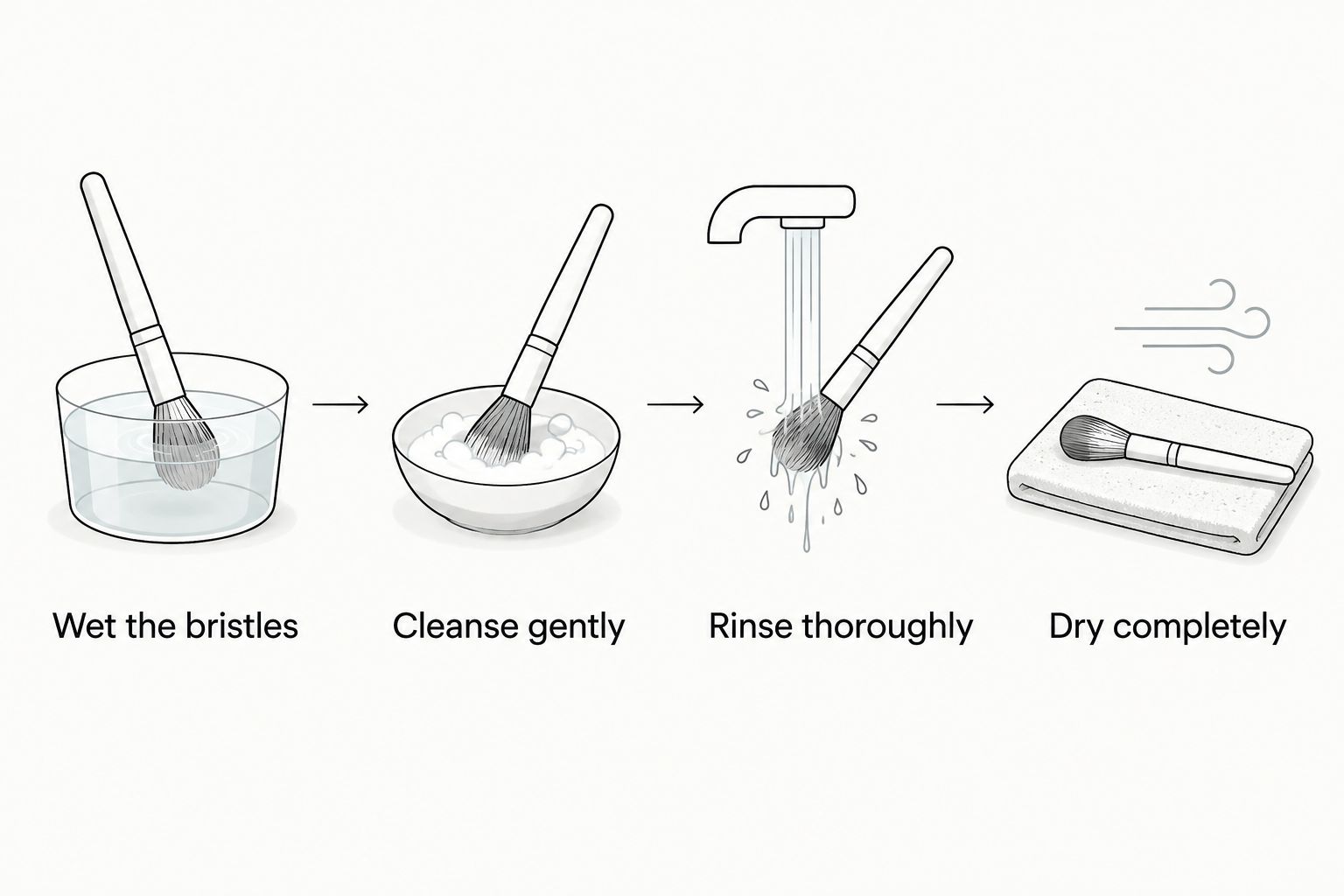
How should you wash your makeup brushes?
For your 2026 brush-care routine, follow the brush manufacturer's instructions first, particularly for specialty fibers or unusual handles. For standard washable makeup brushes, the American Academy of Dermatology's approach provides a straightforward starting point.
Wet the bristles
Rinse the brush tips under lukewarm running water. Keep the focus on the bristles rather than submerging the whole brush head and handle.
The metal band that holds the bristles is called the ferrule. Avoid soaking that area: prolonged water exposure can affect the adhesive holding the brush together.
Cleanse gently
Use a brush-compatible cleanser or gentle shampoo as directed. Work it through the bristles without grinding, pulling, or scrubbing aggressively against a rough surface.
Pay attention to the interior, not only the tips. A dense foundation brush needs cleanser worked through the areas where makeup collects, while a fluffy powder brush needs gentle handling to preserve its shape.
Rinse thoroughly
Rinse out the loosened makeup and cleanser. Repeat gentle cleansing if visible residue remains rather than covering the brush with another product.
Cleanser left behind is still residue. Finish the rinse before moving to drying, and do not use fragrance as your test of whether the brush is ready.
Dry completely
Gently squeeze out excess water with a clean towel, reshape the bristles, and lay the brush flat with its tips over an edge. Avoid drying a wet brush upright, where water can run toward the ferrule.
Let the brush dry fully before using or storing it. A closed makeup bag is a storage space, not a drying rack.
Why does brush cleaning vary?
The basic job stays the same, but your tools and makeup affect how you complete it. Use these factors to adjust your technique—not to decide that misting replaces washing.
- Makeup texture. Liquid and cream formulas coat bristles differently from loose powder. Check for remaining product throughout the brush.
- Brush density. Tightly packed bristles need attention inside the brush head, not just across its surface.
- Fiber type. Follow the manufacturer's care instructions for natural hair, synthetic fibers, or mixed-fiber brushes.
- Product directions. A cleanser's intended use and rinsing instructions matter more than the words on the front of its bottle.
- Drying conditions. Give the bristles space and airflow. Do not pack a damp brush into a closed pouch.
You do not need to invent a different routine for every brush. Start with the manufacturer's care directions, then check that you have actually removed the makeup and rinsed away the cleanser.
Does hypochlorous acid change the answer?
No. Hypochlorous acid in a skincare formula does not turn misting into washing. The ingredient name alone does not establish that a finished product cleans makeup brushes or disinfects them under your conditions of use.
Cleaning and disinfection are different tasks. Cleaning removes material such as dirt and makeup; disinfection involves specific antimicrobial claims and directions. Do not transfer a claim from one formulation, use, or surface to another.
For a 2026 skincare routine, keep the decision label-led. A formula's pH, ingredient count, or water source does not independently prove brush-cleaning performance, and a skincare direction is not automatically a tool-disinfection direction.
Ask a plain question before adding any spray to your brush routine: Does this product explicitly describe this use and explain how to perform it? If not, do not fill the gap with an assumption about its ingredients.
Keep your gym and travel routine simple
Build your 2026 gym bag around separation: clean, dry brushes in one place, used tools kept apart until you can care for them properly. A face mist belongs in its own label-directed routine, not in the role of an improvised brush wash.
Before a trip, wash your brushes early enough for them to dry completely. Pack only the tools you expect to use, and protect the bristles from rubbing against loose cosmetics in your bag.
If you return from the gym with a used brush and no place to wash it, do not treat a quick mist as a reset. Set the brush aside for proper cleaning and choose an already-clean tool when you next apply makeup.
This approach has a practical advantage: fewer decisions when you are rushed. It also has a limit—you still need time and a suitable place to wash and dry the brushes. A small routine works best when it includes that unglamorous step.
Does a natural soap make a better brush cleanser?
Not automatically. A natural label does not tell you whether a cleanser suits your brush fibers, removes your makeup well, or rinses away as directed. Brush compatibility and clear instructions are more useful selection criteria.
The same care involved in reading soap ingredient lists applies here: identify what is actually in the formula instead of treating a front-label description as the full explanation. An ingredient list informs your choice, but it does not establish performance on its own.
If you already own a cleanser, check its intended use before assigning it another job. A facial cleanser, hand soap, and brush cleanser are not interchangeable merely because each cleans something.
Avoid building a homemade mixture from unrelated products. Combining a face mist with soap does not create a verified brush-cleaning formula; it makes the final mixture harder to assess and takes you away from the original directions.
For your 2026 routine, choose a brush-compatible cleanser you can use consistently and rinse thoroughly. Simple means fewer unsupported substitutions, not fewer cleaning steps.
Where does the wellness mist fit?
Gina Rivera is the founder behind Xoxo Gina HALO™. That founder story gives the brand context; the product's directions should determine its place in your routine.
Xoxo Gina HALO™ Wellness Mist comes in a 5 fl oz / 150 mL size and is described as a hypochlorous acid formula at pH 4.5. Those are product details, not evidence that it replaces washing makeup brushes.
The useful distinction is straightforward: consider the mist for its labeled uses, and keep a separate brush-cleaning process. Bottle size helps you understand the format; pH describes one formulation property. Neither tells you that trapped foundation has been removed from a brush.
Xoxo Gina HALO™ is best considered by shoppers seeking a wellness mist, not a replacement for brush washing. Keep that boundary clear even when you prefer a streamlined bathroom shelf.
Can you use a brush again after spraying it?
Spraying alone does not establish that a used brush is clean. If makeup or oil remains in the bristles, the spray has not replaced the removal you get from washing.
Follow any brush-specific cleaner's directions for reuse and drying. Do not borrow those instructions for a face mist with a different intended use.
Should you wash brushes even if you only use powder?
Yes. Powder brushes still pick up makeup and skin oils, so keep them in your washing routine. The American Academy of Dermatology's 7 to 10 days recommendation provides a general schedule rather than an exemption for powder tools.
Visible buildup is a reason to clean a brush, not a reason to wait until the next scheduled wash. Check the bristles as well as the calendar.
FAQ
Can I use face mist instead of washing my makeup brushes?
No. A face mist does not replace washing with an appropriate cleanser, water, and thorough rinsing. Keep skincare use and brush cleaning separate.
How often should I wash my makeup brushes?
The American Academy of Dermatology recommends washing makeup brushes every 7 to 10 days. Follow your brush manufacturer's care instructions and clean visible buildup rather than waiting for the next scheduled wash.
Does hypochlorous acid spray clean foundation out of a brush?
Do not treat hypochlorous acid spray as a substitute for washing foundation out of bristles. An ingredient name does not establish that a finished formula removes makeup or is intended for brush cleaning.
Can I put wet makeup brushes straight into my makeup bag?
No. Let washed brushes dry completely before storing them in a closed makeup bag. Lay them flat with the tips over an edge while they dry.
Is a brush-cleaning spray the same as a face mist?
No. A brush-cleaning spray and a face mist have different intended uses and instructions. Read the individual product label rather than treating spray formats as interchangeable.
Is a natural soap automatically suitable for makeup brushes?
No. A natural description does not establish compatibility with your brush fibers or explain how well the cleanser rinses. Choose a brush-compatible cleanser and follow its directions.
One last thing
Make drying part of cleaning—not an afterthought. A carefully washed brush still needs a clean place to rest, its shape gently restored, and enough time to dry before it returns to your makeup bag.
Before your next wash, clear that drying space first. You will finish the whole job instead of reaching the rinsing stage and wondering where to put a wet brush. Keep the mist for its intended routine, and let washing do the work of removing makeup.